
President Message

Diabetes Philippines, Inc. has been in existence for over 60 years. Its objectives and functions have been incorporated in its constitution and by-laws. Recently... Read More

Mission

To be the prime mover of effective prevention and excellent diabetes care in the Philippines.

Vision

We envision fewer Filipinos with diabetes and improved quality of life for Filipinos with diabetes.
Values

  • Integrity
  • Excellence
  • Cooperation
  • Commitment
  • HISTORY OF THE DIABETES PHILIPPINES

    The PULSE of the Philippine Diabetes Association (PDA) began to throb thirty six years ago, in the early part of July 1958. This was about the time when a group of internists and devoted physicians committed to the care, protection and recuperation of the diabetic patient banded together "to form the nucleus of the PDA". It was the aim of this group to unify all interests and entities in the Philippines concerned about diabetes mellitus into a single association. Thus, today, PDA stands as the umbrella organization of all associations involved in the care of the diabetic patient.

    Evolution of the Seal

    1958

    The staff of Aesculapius. A snake entwined in a rod. In roman Mythology, this staff is commonly used to represent Aesculapius, the God of Medicine.

    1992

    A logo consists of two concentric circles bearing the name of our association and the year of its foundation. At the center of the innermost circle is an oversized pair of open hands, holding a family in its palms. The image is an allegory to the care that PDA extends not only to the diabetic patient but to his or her family as well.

    2008

    The latest logo marks the transition towards a new name for our organization. The stylized rendering of the human form alludes to the mission of Diabetes Philippines as the prime mover of effective prevention and excellent diabetes care in the Philippines. The extended arm denotes Diabetes Philippines relentless effort in reaching out to all stakeholders in order to fulfill its vision while the blue circle makes reference to the internationally recognized symbol of Diabetes Melitus

    Read More

    In 1987, the PDA initiated the orgranization of nationwide chapters -- provincial units that would serve the needs of local communities in different regions of the Philippines. Beginning with a single chapter in Davao City, a total of 31 chapters have flourished around the country to date, from as far north as Benguet, to as far south as Zomboanga. And to strengthen the bond between the PDA and its various chapters, while at the same time recognizing the undeniably great contributions of outstanding chapters and promoting each individual chapters' autonomy and initiative, the PDA, in cooperation with pfizer began awarding the Chapter of the Year Award in 2003

    At present, the existing PDA chapters are as follows: Read More .

    Chapters

    What we do

    Education

    The Annual Convention became a venue for the exchange of ideas and the echo of new developments in the field...

    Advocacies & Workshops

    The PDA Diabete Workshop has been a continuing project of the society since it was hosted in Legaspi City by the Albay, Camarines and Sorsogon Chapters in 1990.

    Networking

    The ASEAN Federation of Endocrine Societies(AFES) is an organization composed of Endocrine Societies from Indonesia, Malaysia, Singapore,Thailand ,Vietnam and the Philippines.

    Research

    Diabetes Care.

    Data Collection Project.

    Featured Events

    You are invited to a DP webinar

    Click Image Below to Register

    A confirmation message will be sent to your registered address with your unique link access to the event

    • When: May 25, 2022
    • Day/Time: Wednesday | 12:00nn

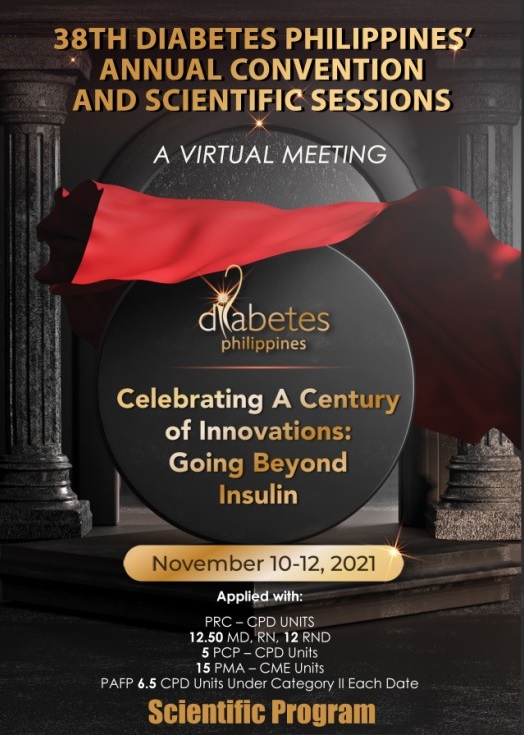
    38th Annual Convention and Scientific Sessions

    A Virtual Meeting

    Applied with:

    • PRC = CPD UNITS.
    • 12.50 MD, RN 12 RND.
    • 5 PCP - CPD Units.
    • 15 PMA - CME Units.
    • AFP 6.5 CPD Untis Under Category II Each Date.

    Workshops

    Column 2

    70th Diabetes Workshop and 35th Diabetes Forum

    2022-04-29
    Monarch Hotel, Pangasinan April 17 – 18, 2020 (Friday – Saturday) Coordinators: Dr. Nines P. Bautista and Dr. Lalaine Duque

    71st Diabetes Workshop and 36th Diabetes Forum

    2022-04-30
    Tentative Venue: Villa Caceres Hotel, Camarines Sur July 9 – 10, 2020 (Thursday – Friday) Coordinators: Dr. Nines P. Bautista and Dr. Joseph R. Bongon, Jr.

    72nd Diabetes Workshop and 37th Diabetes Forum

    2022-04-30
    Davao (exact venue to follow) August 7 – 8, 2020 (Friday - Saturday) Coordinators: Dr. Nines P. Bautista and Dr. Grace Aquitania

    Outreach & Advocacy

    DiabetesWatch was first published in 1983,it was envisioned to be a public service tool of the society, to bring news nad information about diabetes to the medical world and the general publid

    DiabetesWatch started as a black-and-white newsletter released twice a year. Despite uts minimalism, it easily became a member of the International Committee of Diabetes Magazines under the International Diabetes Association

    Gimik

    World Diabetes Day is celebrated on November 14th annually. This date commemorates the birth of Frederick BAnting in 1891 in Canada, who received the Nobel Prize jointly with J.J.R. Maclead (1876-1935), for their discovery of insulin in 1921.

    Each year World Diabetes Day is thematically linked to a specific aspect related to diabetes. Themes in the past have focused on diabetes and human rights, diabetes and lifestyle, and the cost of diabetes.

    Since 2001 particular attention has been paid to diabetes complications affecting

    • the heart
    • the eyes
    • the kidneys
    • and the foot

    Although the Philippines has its own Diabetes Awareness Week celebration, in keeping with the IDF , the PDA celebrates World Diabetes Day each year. It is celebrated simultaneously in nationwide events through the PDA chapters.

    Upcoming

    Column 2

    Announcement and Invitation

    FIRST 250 patients to register get a FREE FreeStyle Libre starter kit worth Php 7,000!

    Know more how life changing technology like FreeStyle Libre can help you manage your diabetes by seeing the whole picture of your glucose levels.

    Patients can register by scanning the QR code below or thru https://bit.ly/3HWSxvv

    HCP can signify intent to participate in the FreeStyle Libre Group Start thru https://bit.ly/3HCivDv

    QUALIFICATIONS:

  • 1. Insulin-using patients.
  • 2. Capable to continue using FreeStyle Libre.
  • 3. Can create LibreView account using laptop and share results with doctor with the assistance of Abbott RND’s.
  • 4. Should virtually attend onboarding sessions on FreeStyle Libre and LibreView via Zoom.

    *Abbott and Diabetes Philippines, Inc. reserve the right to validate patient qualifications.

  • F.A.Q

    Diabetes is usually a lifelong disease in which there is a high level of sugar in the blood. Diabetes affects more than 20 million Americans. In addition, over 40 million Americans have pre-diabetes. To understand diabetes, it is important to first understand the normal process by which food is broken down and used by the body for energy.

    When food is digested, a sugar called glucose enters the bloodstream. Glucose is a source of fuel for the body. Then, an organ called the pancreas makes insulin. The role of insulin is to move glucose from the bloodstream into muscle, fat, and liver cells, where it can be used as fuel.

    People with diabetes have high blood sugar because their body cannot move sugar into fat, liver, and muscle cells to be stored for energy. This is because their pancreas does not make enough insulin and/or their cells do not respond to insulin normally. After many years, diabetes can lead to other serious problems. These complications include: eye problems, painful sores and infections of the leg or foot, nerve damage, kidney problems, weakened immune system, and an increased risk heart attack or stroke.

    • What are the types of diabetes?

      Type 1 diabetes

      Type 1 diabetes accounts for about 5% of all diagnosed cases of diabetes. Type 1 is usually diagnosed in children and young adults, although it can occur at any time. People with type 1 diabetes must use insulin from an injection or a pump to manage their diabetes.

      Type 2 diabetes

      Type 2 diabetes accounts for about 95% of all cases diagnosed in adults. Several studies have shown that healthy eating, regular physical activity, and weight loss used with medication if prescribed, can help control complications from type 2 diabetes or can prevent or delay the onset of type 2 diabetes.

      Gestational diabetes

      Gestational diabetes is diagnosed in 2 to 10% of pregnant women. Gestational diabetes can cause health problems during pregnancy for both the child and mother. Children whose mothers had gestational diabetes have an increased risk of developing obesity and type 2 diabetes. Although gestational diabetes often goes away after pregnancy, about half of all women who have gestational diabetes get type 2 diabetes later in life.

    • Being very thirsty

      Urinating often

      Feeling very hungry

      Feeling very tired

      Losing weight without trying

      Sores that heal slowly

      Dry, itchy skin

      Feelings of pins and needles in your feet

      Losing feeling in your feet

      Blurry eyesight

      Some people with diabetes don’t have any of these signs or symptoms. The only way to know if you have diabetes is to have your doctor do a blood test.

    • Urine analysis

      A urine analysis may show high blood sugar. But a urine test alone does not diagnose diabetes. Your health care provider may suspect that you have diabetes if your blood sugar level is higher than 200 mg/dL. To confirm the diagnosis, one or more of the following tests must be done.

      Blood tests

      Fasting blood glucose test, hemoglobin A1c test, and oral glucose tolerance test are blood test that can be done to diagnose diabetes.

      Screening

      Screening for type 2 diabetes in people who have no symptoms is recommended for: overweight children who have other risk factors for diabetes (starting at age 10), overweight adults (BMI greater than 25) who have other risk factors, and adults over age 45.

    • Being overweight or obese/p>

      Having a parent, brother, or sister with diabetes/p>

      Being African American, American Indian, Asian American, Pacific Islander, or Hispanic American/Latino heritage/p>

      Having a prior history of gestational diabetes or birth of at least one baby weighing more than 9 pounds/p>

      Having high blood pressure measuring 140/90 or higher/p>

      Having abnormal cholesterol with HDL ("good") cholesterol is 35 or lower, or triglyceride level is 250 or higher/p>

      Being physically inactive—exercising fewer than three times a week

    • Research has shown that the following lifestyle modifications can prevent, or at least delay the onset of type 2 diabetes among people at risk of diabetes:

      Eating fewer high fat and high calorie foods

      Losing at least 5%-7% of body weight (if overweight)

      Being physically active for 150 minutes every week

    Videos

    Play More

    Diabetes Prevention

    Active

    World Diabetes Day

    Active

    Covid19 Hydrated Protection

    Active

    News

    Recent

    Breaking News

    Infomercials

    • All
    • App
    • Card
    • Web

    App

    "Gallery/Infomercial/App/COVID19_Prepare.jpg"

    App

    "Gallery/Infomercial/App/FreeStyleLibre_1.jpg"

    App

    "Gallery/Infomercial/App/FreeStyleLibre_2.jpg"

    App

    "Gallery/Infomercial/App/FreeStyleLibre_3.jpg"

    App

    "Gallery/Infomercial/App/hand.jpg"

    App

    "Gallery/Infomercial/App/COVID19_PreventionX.png"

    Card

    "Gallery/Infomercial/Card/diabetes_day_142022.jpg"

    Web

    "Gallery/Infomercial/Web/obesity.jpg"

    Web

    "Gallery/Infomercial/Web/pic02.jpg"

    Related Sites